Shotokan Karate Stances
As a beginner or as an advanced karateka it is necessary to learn the basic techniques to achieve your own understanding of how your body moves. In this section we show the initial stances we all learn and seek to improve. There are other stances, however these are the key ones that should be practiced in every training session.
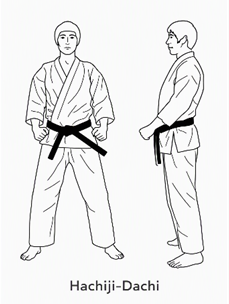
Soto Hachiji Dachi (open v stance)
The heels are placed shoulder width apart with toes pointing outward at a slight angle.
Hachiji [1} is the kanji character for the number eight 八.
Hence the open v stance copies this kanji character form
Heiko dachi (open parallel stance)
The heels are placed shoulder width apart with the toes pointing forward so that the feet are parallel to each other.

Zenkutsu dachi (front stance)
The forward leg is bent at the knee, and the rear leg straight. The distance between the feet is about the width of the shoulders, and the distance from the back foot to the front foot is around one and a half to two shoulder widths. The purpose of the front stance is to provide stability while projecting the body weight forwards, such as when punching. The straight rear leg pushes the centre of gravity forwards, ensuring the full body weight is behind the strike.

Kokutsu dachi (back stance)
The back stance is designed to help defend yourself and avoid strikes from an aggressor. However, it can also be applied to an attacking move.
Place your feet together at a 90 degree angle. Push the front foot out about the distance of 1 to 1 ½ shoulder width from the back foot. Bend the knees and place about 70% of your weight onto the back foot and 30% onto the front foot. In this position it should be easy to lift the front foot off the floor without shifting weight or altering posture.
Moving will require a transition through a central position with both knees bent and both feet together. Bring the back foot to the front foot. Continue moving the back foot forward and adopt the position described above, except this time you with have changed foot positions

Kiba dachi (horse riding stance)
This is a very strong stance for dealing with attacks from the side.
Place your feet about 1 ½ to 2 shoulder widths apart. The toes of the feet should point forward. Bend both knees into a deep squat. Even weight distribution over both feet.
Moving requires transition through central position moving one foot over the other, planting it and moving the other foot forward performing hip rotation to end in position with both feet pointing forward. Very often it is taught in the beginning with no hip rotation through the transition.
